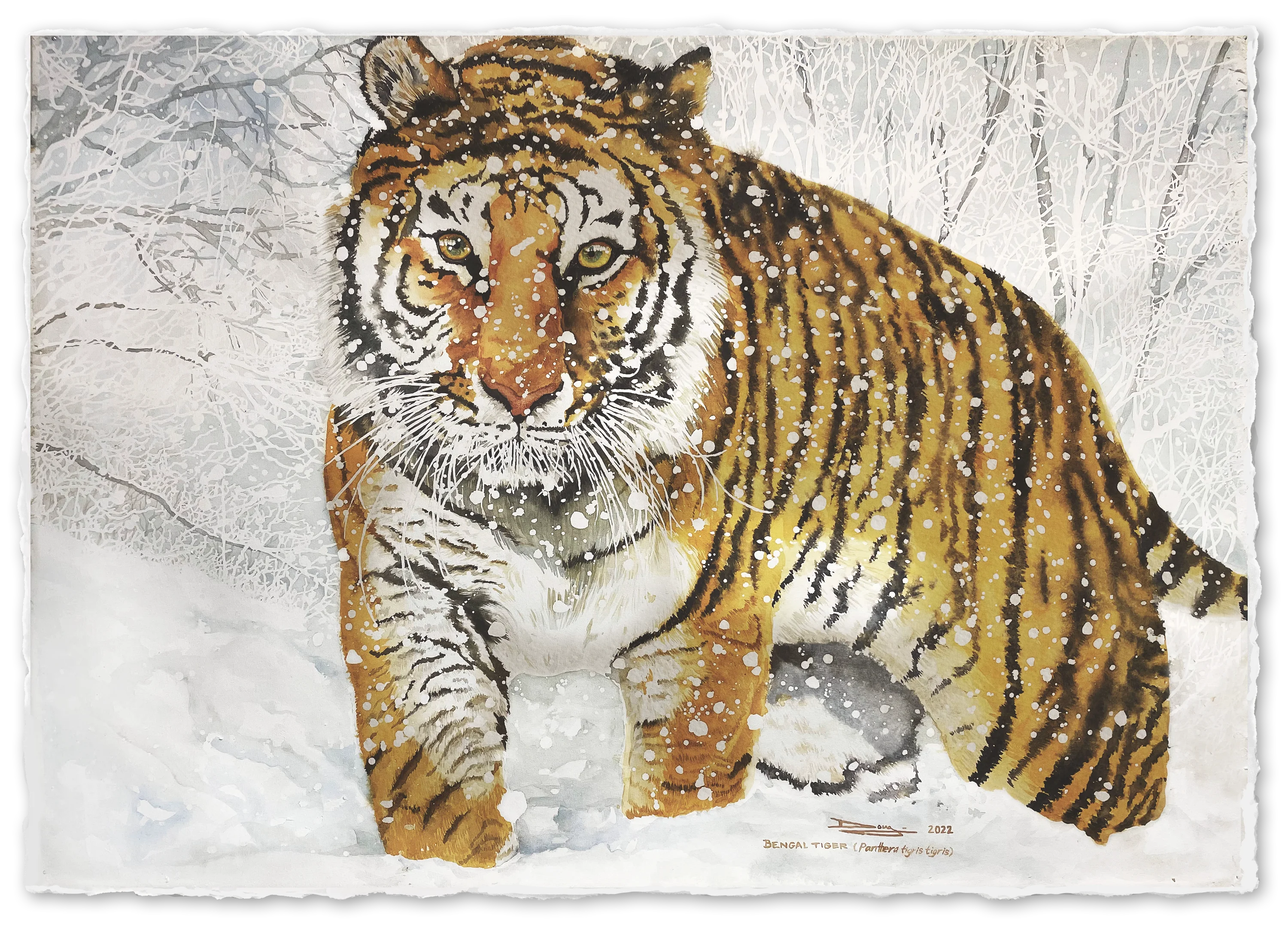
Bengal Tiger (Panthera tigris tigris)

Watercolor, 31″ x 30″, on Hahnemühle Watercolor Collection CP 140lb: $8,000.00

About Bengal Tigers

Bengal tigers live in India, Bangladesh and Nepal. They are the most common tiger and number about half of all wild tigers. Over many centuries they have become an important part of Indian tradition and lore.

Tigers live alone and aggressively scent-mark large territories to keep their rivals away. They are powerful nocturnal hunters that travel many miles to find buffalo, deer, wild pigs, and other large mammals. Tigers use their distinctive coats as camouflage (no two have exactly the same stripes). They lie in wait and creep close enough to attack their victims with a quick spring and a fatal pounce. A hungry tiger can eat as much as 60 pounds in one night, though they usually eat less.

Despite their fearsome reputation, most tigers avoid humans; however, a few do become dangerous maneaters. These animals are often sick and unable to hunt normally or live in an area where their traditional prey has vanished.

Females give birth to litters of two to six cubs, which they raise with little or no help from the male. Cubs cannot hunt until they are 18 months old and remain with their mothers for two to three years, when they disperse to find their own territory.

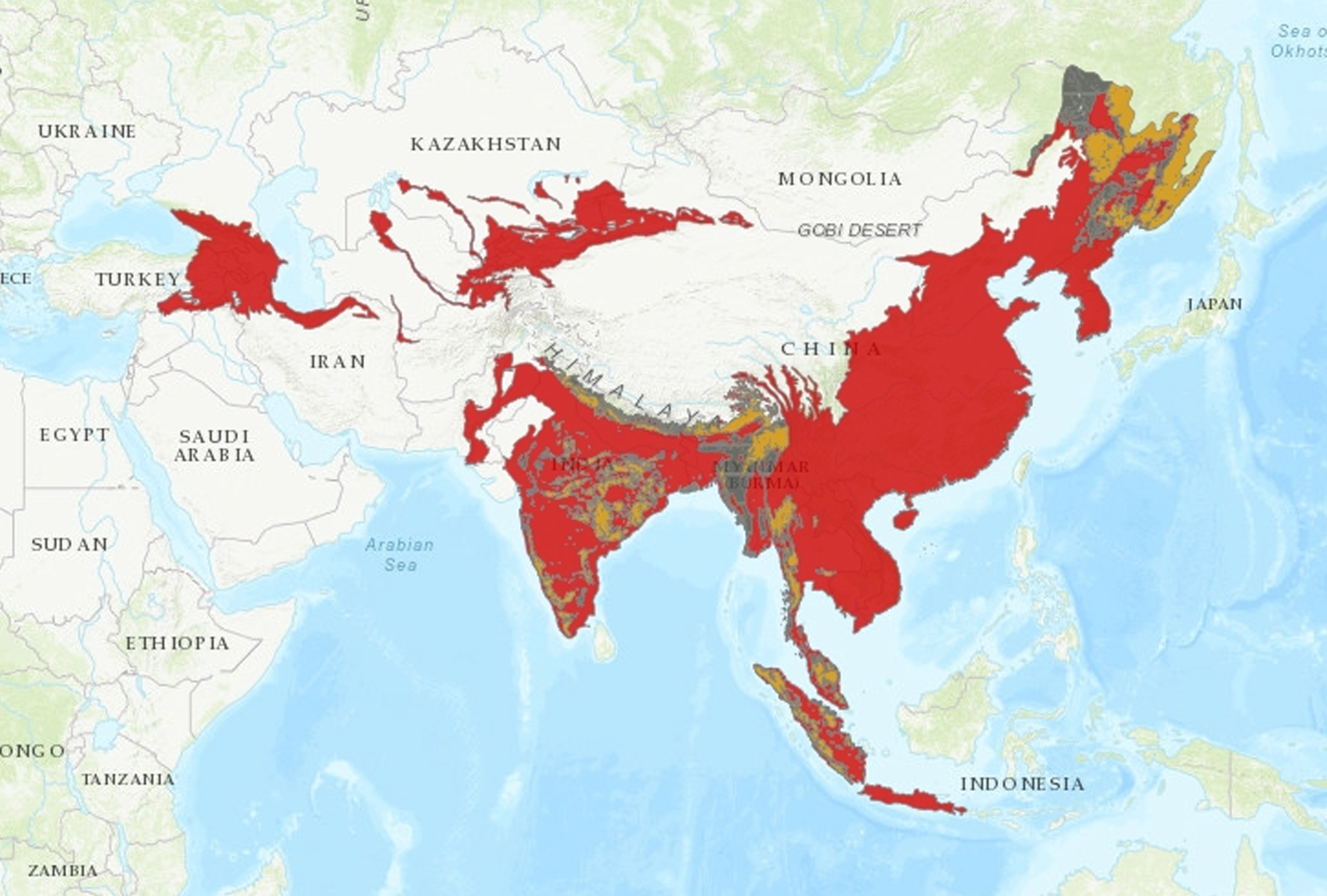
Historic and Current Range Map of the Bengal Tiger worldwide
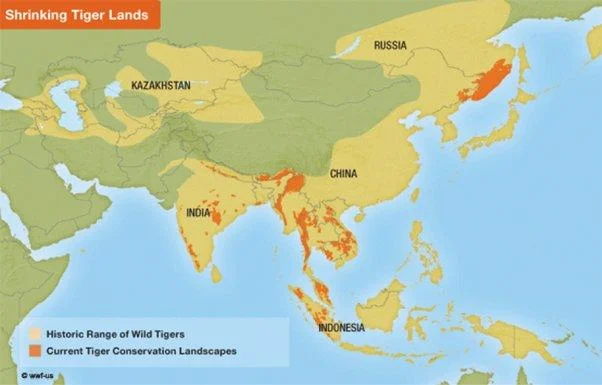
Bengal Tigers (Panthera tigris tigris) are known to be wide-ranging animals, meaning they occupy huge territories, and can be found in India, Bangladesh, and Nepal. In India, they are spread across a variety of habitats, be it tropical rain, deciduous, evergreen, or mangrove forests, or Terai grasslands. And now, the snow-capped mountains of the eastern Himalayas are included in the list.

 A three-year study has produced the first-ever evidence of Indian tigers thriving in snow-covered mountains on the north-eastern tip of India in Arunachal Pradesh. These snow-comfortable tigers were photographed by camera traps at altitudes of 3600 meters above sea level.

A team of researchers took thousands of pictures using camera traps spread across the Dibang Wildlife Sanctuary and the Mishmi Hills. In some of these pictures, tigers were seen walking across the snow. 

Range Map of the Bengal Tiger in Chitiwan Park
About the painting:

I used photos of a male Bengal tiger taken at Arunachal Pradesh, and added some background foliage and a haze of falling snow. The branches and twigs on the background, and each snowflake, were masked using Holbein liquid frisket. The paper, Hahnemühle Watercolor Collection 140lb (oversized, at 38” x 30”) was chosen for its excellent frisket handling properties.,The compromise is that it is almost impossible to reactivate and blend dry paint and the paper does not lift at all. So my wet-on-wet technique has to be executed quite a bit more quickly than my preferred pace, and once laid down each brushstroke was indelibly stained.

The background involved more work and took much longer than the tiger itself, but plays an integral part, I think, in setting the mood as the intense staring big cat stalks toward to viewer in a snow storm.

My Tiger Conservation Commitment

25% of all proceeds 

from Bengal tiger art and merchandise is donated to Ranthambore National Park in Rajasthan, one of India’s leading tiger sanctuaries and wildlife destinations, with a population of up to 80 tigers.

Buy the Original or Prints

Coming Soon: Custom Frames and Matt boards - Over 100 styles!!!

Scroll to Top

PANTHERA

Panthera focuses its conservation efforts on imperiled cats, including tigers, lions, jaguars, snow leopards, pumas and cheetahs.

In 2011, we merged with Save the Tiger Fund, which supported hundreds of wild tiger conservation projects across tiger range states in Asia. This partnership combines decades of experience and success in identifying conservation priorities, using best practices and implementing proven strategies to address the many challenges that wild tigers face.

40+

Countries where Panthera actively protects wild cats, across eight regions.

35+

Partnerships with government agencies to sustain lasting change.

45+

Counter-Wildlife Crime information hubs around the globe.

30,000+

Motion Acivated Cameras produced to date: Over 26 million images from motion-activated cameras since 2012 from 466 data set in 25 countries. Over 470 different species and over 5,000 different individually identified cats (i.e., leopards, jaguars, tigers, ocelots and more).

600+

Rangers, judges, support staff, problem analysts and prosecutors. With partners by our side, a collaborative process to protect tigers is mobilizing like never before. And in 2020, we stepped up our efforts by establishing offices in Thailand and Malaysia.

1,000+

Individual tigers monitored, analyzed and reported on by core teams and partner organizations, being the major contributor to IUCN Redlist data on tiger population status worldwide

Our Goals

  • Recover tiger source sites.
  • Support a 50% increase in tiger numbers within ten years.
  • Create a network of functionally connected source populations.

Where we Work

Countries: Malaysia and Thailand. We also work with organizations and government entities in India, Indonesia and Nepal.

PANTHERA

Panthera focuses its conservation efforts on imperiled cats, including tigers, lions, jaguars, snow leopards, pumas and cheetahs.

In 2011, we merged with Save the Tiger Fund, which supported hundreds of wild tiger conservation projects across tiger range states in Asia. This partnership combines decades of experience and success in identifying conservation priorities, using best practices and implementing proven strategies to address the many challenges that wild tigers face.

40+

Countries where Panthera actively protects wild cats, across eight regions.

35+

Partnerships with government agencies to sustain lasting change.

45+

Counter-Wildlife Crime information hubs around the globe.

30,000+

Motion Acivated Cameras produced to date: Over 26 million images from motion-activated cameras since 2012 from 466 data set in 25 countries. Over 470 different species and over 5,000 different individually identified cats (i.e., leopards, jaguars, tigers, ocelots and more).

600+

Rangers, judges, support staff, problem analysts and prosecutors. With partners by our side, a collaborative process to protect tigers is mobilizing like never before. And in 2020, we stepped up our efforts by establishing offices in Thailand and Malaysia.

1,000+

Individual tigers monitored, analyzed and reported on by core teams and partner organizations, being the major contributor to IUCN Redlist data on tiger population status worldwide

Our Goals

  • Recover tiger source sites.
  • Support a 50% increase in tiger numbers within ten years.
  • Create a network of functionally connected source populations.

Where we Work

Countries: Malaysia and Thailand. We also work with organizations and government entities in India, Indonesia and Nepal.