
"Moneypenny" the secretary bird from Kenya bird of prey trust
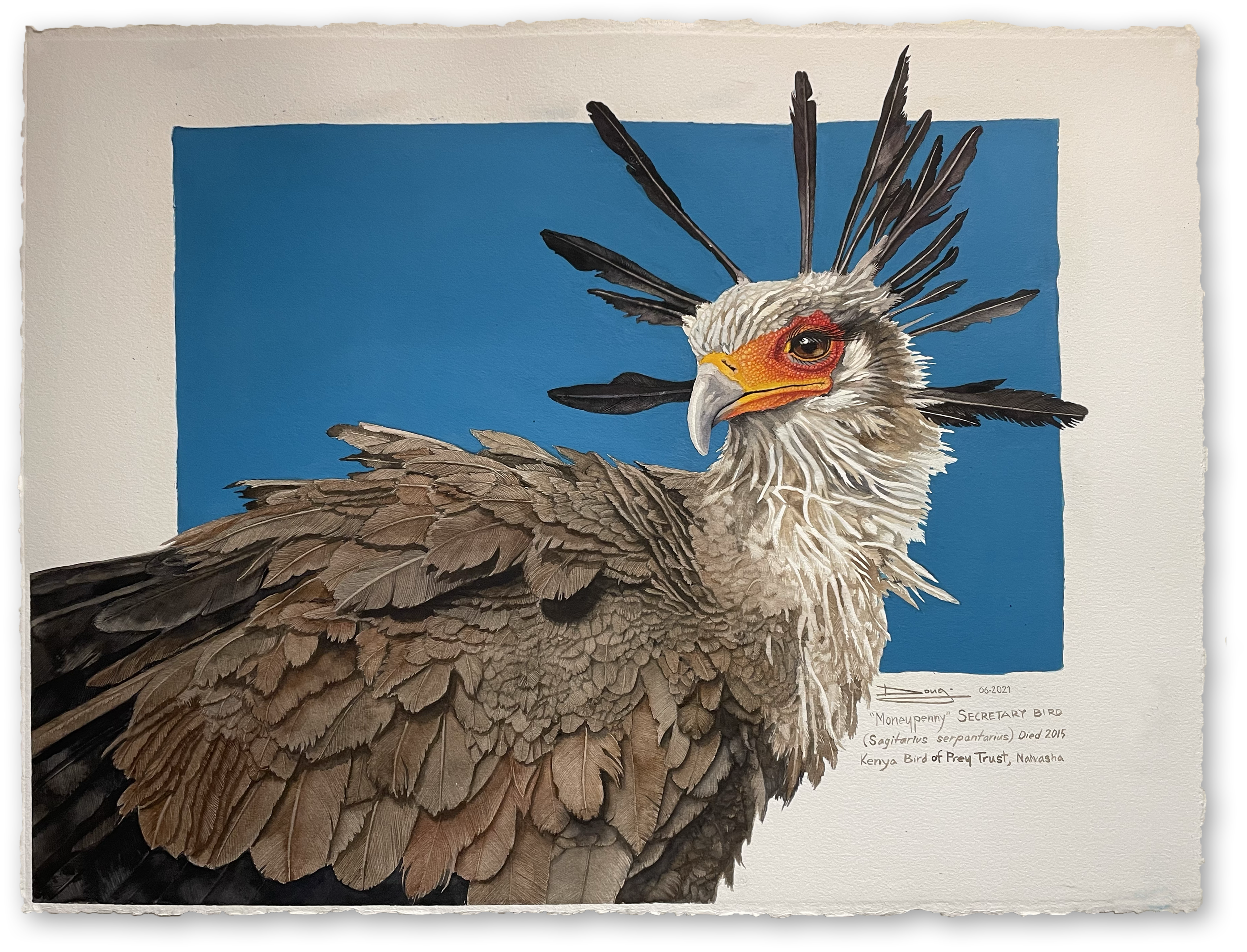
Watercolor, 30″ x 22″, on Lanaquarelle rough 300lb: $8,000.00
To zoom in, click on the image, then click the magnifying glass in the upper right corner of the page.
The Secretary Bird (Sagitarius serpentanius)
About Secretary Birds
Adapted from the National Geographic website:
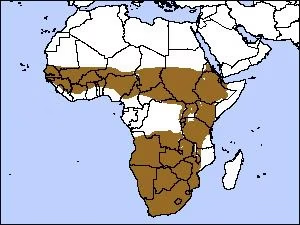
These raptors of of sub-Saharan Africa’s savannas, grasslands, and shrub lands stand at nearly four feet tall—and standing is often how you’ll find them, because they primarily move around on foot. They fly only when necessary, such as to reach their nest in the trees and for courtship displays. They typically prey on snakes, lizards and rodents, by flapping their wings for lift and balance and striking out with their impressively strong and sharp talons. They have quicker reactions than a black mamba snake!
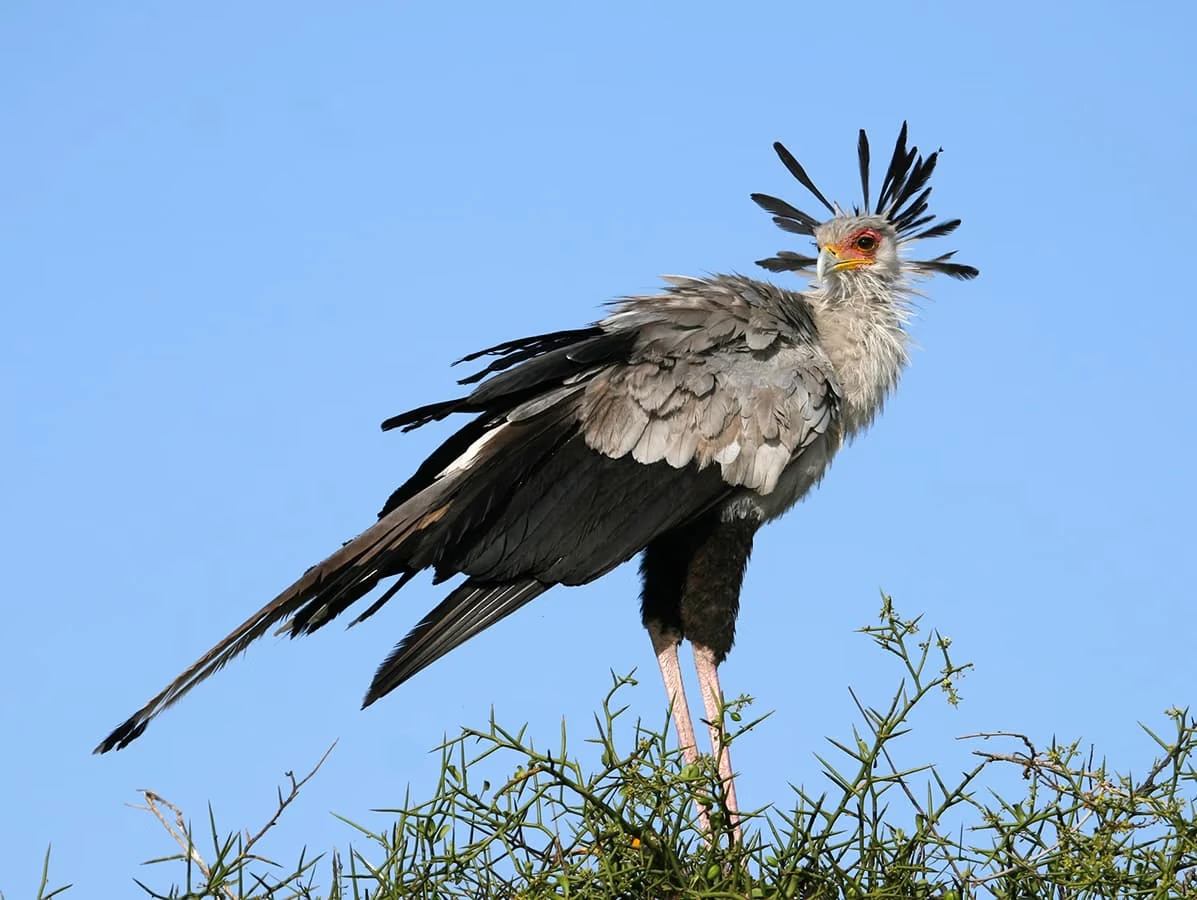
The secretary bird is distinguished by its long legs and a dramatic black crest of feathers on the back of its head. Its body is covered in whitish-gray feathers, with two long, black-tipped tail feathers. Its bare face is usually yellow, orange or red.
The top half of its long legs has black feathers, so it looks a bit like it’s wearing bicycle shorts. The lower half is covered with scales and has barely visible feathers.
While it’s not known for certain where the name “secretary bird” comes from, one explanation is that they’re named after 19th century lawyer’s clerks, or secretaries. Secretaries typically wore gray coats and knee-length black pants, and they would tuck quill pens behind their ears, similar to the bird’s coloring and head feathers.
Human encroachment on secretary birds’ natural habitat has led the species to be classified as vulnerable to extinction. Some of its grasslands habitat has been burned and cleared for livestock. Those open areas leave little protection for prey animals, making it hard for secretary birds to find food. Some secretary birds can make do in human-created open areas by scavenging small animals that didn’t escape the fires or other predators. The presence of humans—mainly herders—is known to interfere with secretary bird breeding.
Secretary birds can be found in a number of protected areas across their large range, but scientists say better monitoring is needed to track their numbers and quantify their decline in some areas.
The International Union for the Conservation of Nature (IUCN) listed the secretary bird in 2016 as a vulnerable species and as Endangered in 2020, due to a recent rapid decline across its entire range.
About Moneypenny at Kenya Bird of Prey Trust
Moneypenny was discovered on the Maasai Mara with a mutilated leg in October 2014. Beyond treatment, due to delays in her discovery, the leg was amputated when she got to Kenya Bird of Prey Trust in Naivasha. Simon Thomsett, one of KBoP’s founders created a bamboo prosthesis, which Moneypenny (named after James Bond’s secretary), adapted to quite well. Unfortunately on a very cold night Moneypenny got tangled up with her prosthetic limb and ended up sprawled on the cold ground, dying of hyperthermia overnight.
Range Map of the Secretary Bird

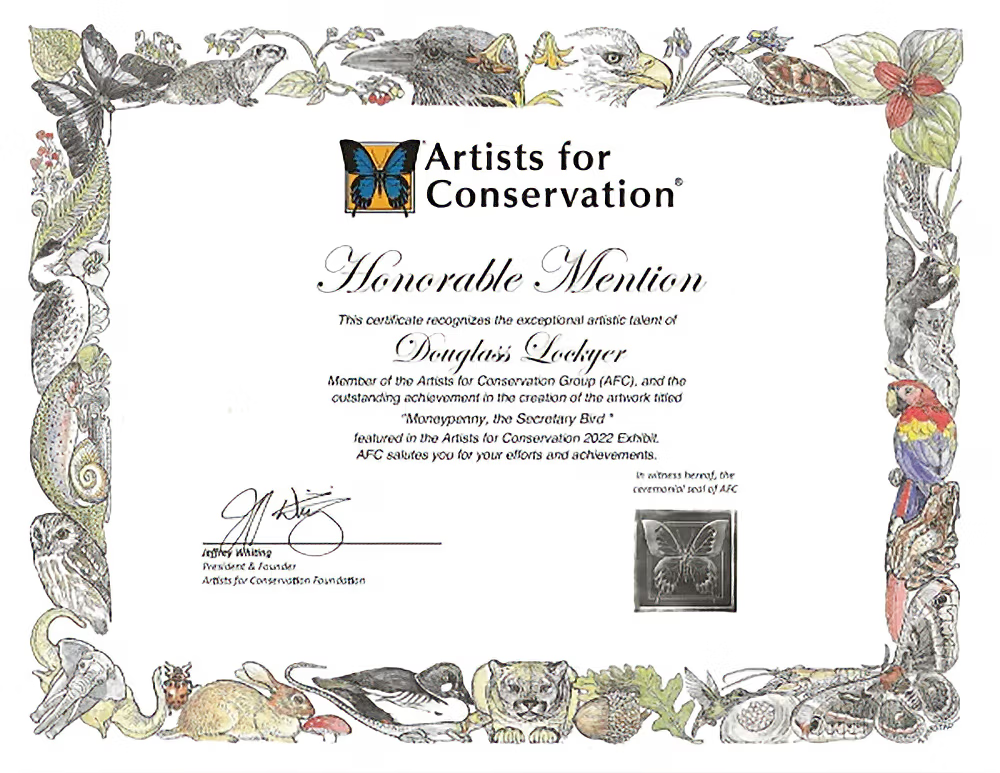
Winner, 2022 Artists for Conservation “Honorable Mention” Award
About the painting:
I never got the chance to meet Moneypenny, so this painting is characterized as “inspired by stories of” rather than a traditional portrait.
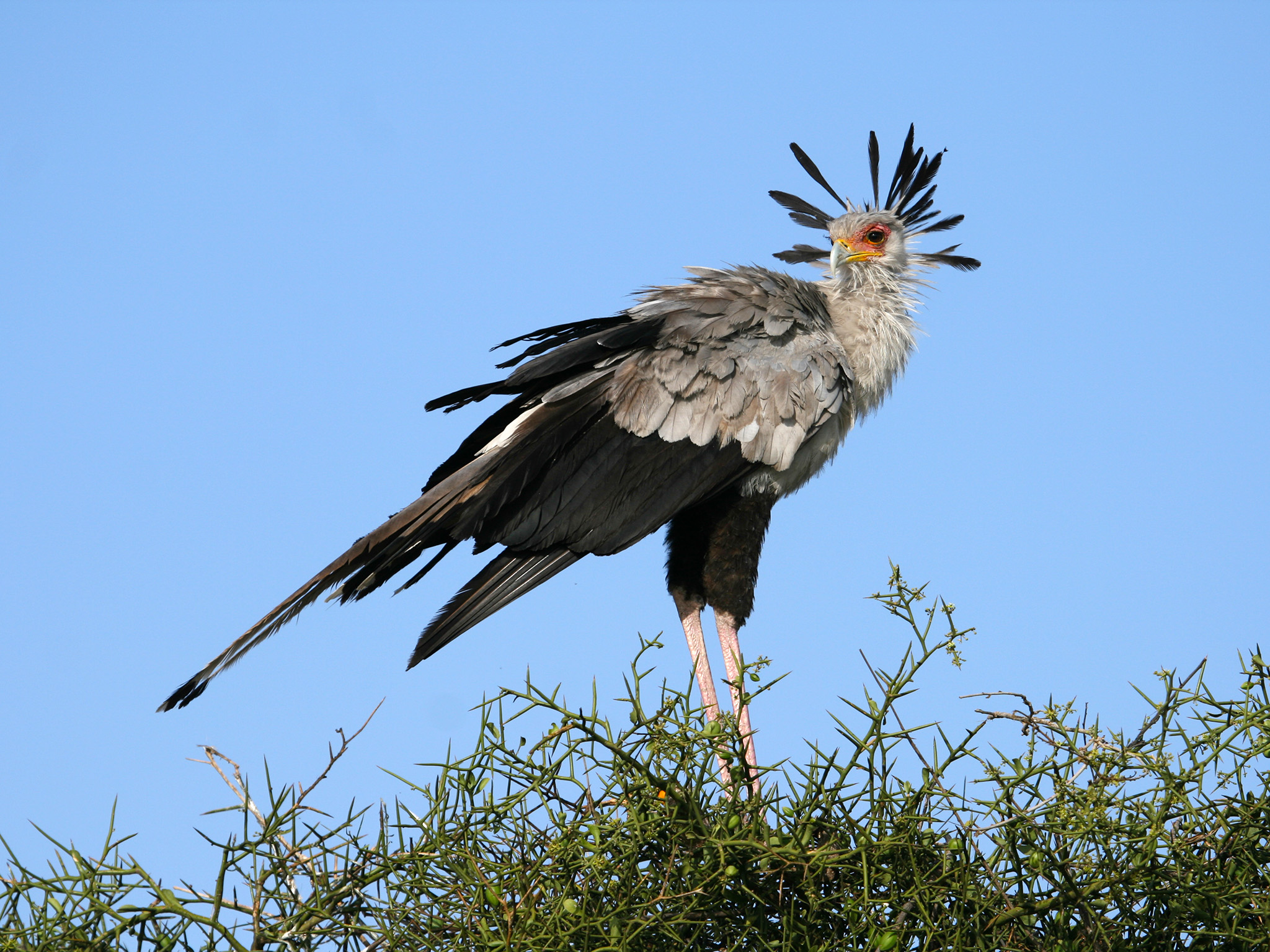
I found the image I wanted to paint, which was coincidentally taken by my friend Simon Thomsett, the co-founder (along with Shiv Kapila) of Kenya Bird of Prey Trust. He kindly, if after the fact, gave me his permission to use it as a reference.
Simon’s fantastic reference photo
For this painting I wanted to attempt a pure watercolor – no aquarelle pencils (except for parts of the face) and no gouache overpainting of feathers(though the matt background panel was done using gouache, which allows for very flat consistent color). This meant that every one of the many thousands of barbules highlights across all the feathers is painted by reverse, exposed-paper technique, so all the pale strands of feathers are painted around in darker pigment to leave the paler glaze showing as the feather. It is infinitely time consuming and slightly less realistic than simply painting feather barbs light-over-dark using gouache, but it’s also a bit satisfying in a perverse way, to stick to the purist “rules” of watercolor. I did use gouache and aquarelle pencils to add dimension to the pebbled skin around the eye. Also, the only black pigment used in the painting is black gouache in the eyelashes. The black for feathers was produced by combining Payne’s Grey, VanDyke Brown, Prussian Blue and Alizarin Crimson. The pinkish grey feathers are a result of mixing Burnt Umber, Payne’s Gray and Burnt Sienna.
My Secretary Bird Conservation Commitment
25% of all proceeds
from “Moneypenny” artwork and merchandise goes to Kenya Bird of Prey Trust for their Raptor Rescue programmes.
Buy the Original or Prints
Coming Soon: Custom Frames and Matt boards - Over 100 styles!!!