
Grey Crowned Crane
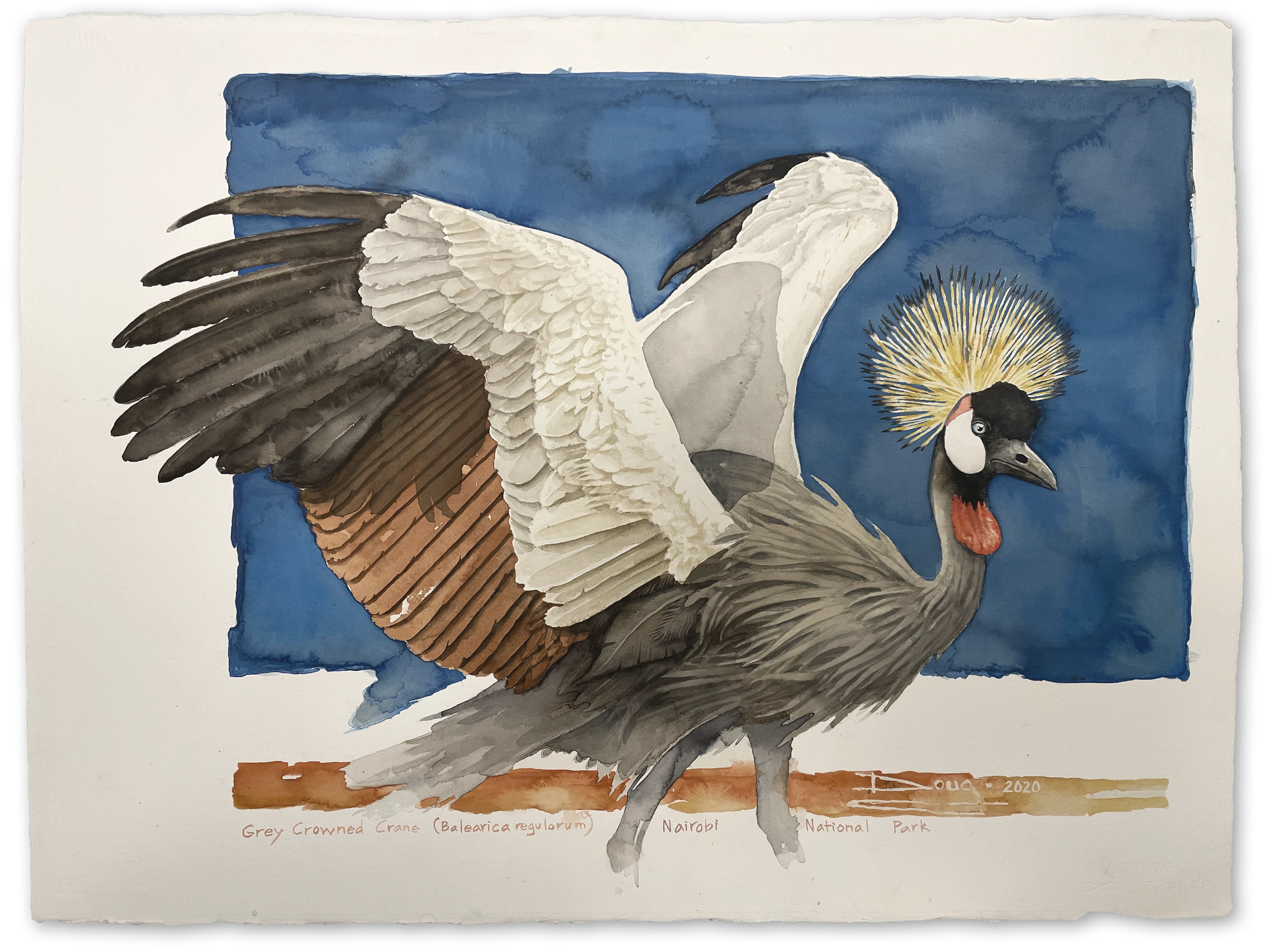
Watercolor, 30″ x 22″, on Arches rough 300lb. $4,000.00
To zoom in, click on the image, then click the magnifying glass in the upper right corner of the page.
The grey crowned crane (Balearica regulorum)
About Grey Crowned Cranes
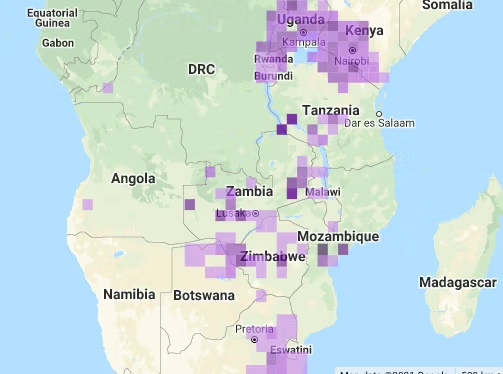
The grey crowned crane has a range, which stretches from the eastern Democratic Republic of Congo, through Uganda and Kenya to southeastern South Africa. Grey Crowned Cranes are non-migratory, but undertake variable local and seasonal movements and are most abundant in Uganda, Kenya and Tanzania.
“A spectacular, mostly blue-gray crane with a black-and-white face and a crown of golden-yellow plumes. Immatures are rustier than adults. Singles, pairs, and flocks prefer wetlands, flooded grasslands, and man-made water bodies, but they can range widely through other open habitats when foraging. Resident but may be locally nomadic in response to rain. Groups can often be detected by their low plaintive bugling “maaah-hem” call. The similar Black Crowned-Crane differs in having slaty-gray coloration, smaller red facial wattles, and red-and-white (rather than white) cheek patches.”
– E-bird
Grey Crowned Cranes of Naivasha
The Naivasha wetland represents an area where wetland climatic conditions converge to create an ideal habitat for wading birds such as ibises and grey crowned cranes. The grey crowned crane’s conservation status has recently been upgraded to endangered, and there are only only 25,000 to 30,000 remaining and are on the decline in Kenya.
Range Map of the Grey Crowned Crane
About the painting:
The inspiration for this painting came from encountering the pair of resident, quite tame crowned cranes who live on the grounds of the Kenya Bird of Prey Trust. I couldn’t get a perfect photo however so I used a fabulous photo taken by Shawn Olesen as my primary reference.
I started this project on my laptop, by compositing the crane against a “golden ratio” flat panel of blue, with a separated lower strip to represent a horizon line, then sketched in a detailed outline using my pressure sensitive Intuos graphics tablet. Once I had outlines that I liked I printed them out and taped them down to my large format lightbox. I use the lightbox rather than graphite transfer paper or pencil drawings to leave the watercolor paper free of any outlines.
I then taped over a 30” x 22” piece of Canson XL cold press paper, which, once I started trying to lay in soft color bleeds, proved disastrous, as it stained as if I were painting on blotter paper with felt tip pens! I started over with Arches Rough 100% cotton watercolor paper (which I had to buy while visiting my daughter in Atlanta, as there is no Arches in Kenya!).
I used Van Gogh and Winsor & Newton paints, applying broad background washes first, then laid in the base body and head textures using a combination of wet on wet, dry brush and wet on dry washes. I used small amounts of sea salt to form the texture patterns of the cap and wattles, and deliberate “bloom” backwash effects in the background.
You can see the stage-by-stage progress in my CREATIVE PROCESS section.
I am donating 50% of the proceeds from an upcoming fundraising auction towards the Kenya Bird of Prey Trust, who run raptor programs on a minimal budget in Naivasha. Many thanks to Shiv Kapila and Simon Thompsett for their hospitality and support.
My Grey Crowned Crane Conservation Commitment
25% of all proceeds
from “Gene” artwork and merchandise goes to Kenya Bird of Prey Trust for their Raptor Rescue programmes.
Buy the Original or Prints
Coming Soon: Custom Frames and Matt boards - Over 100 styles!!!