
Saddle Billed Stork
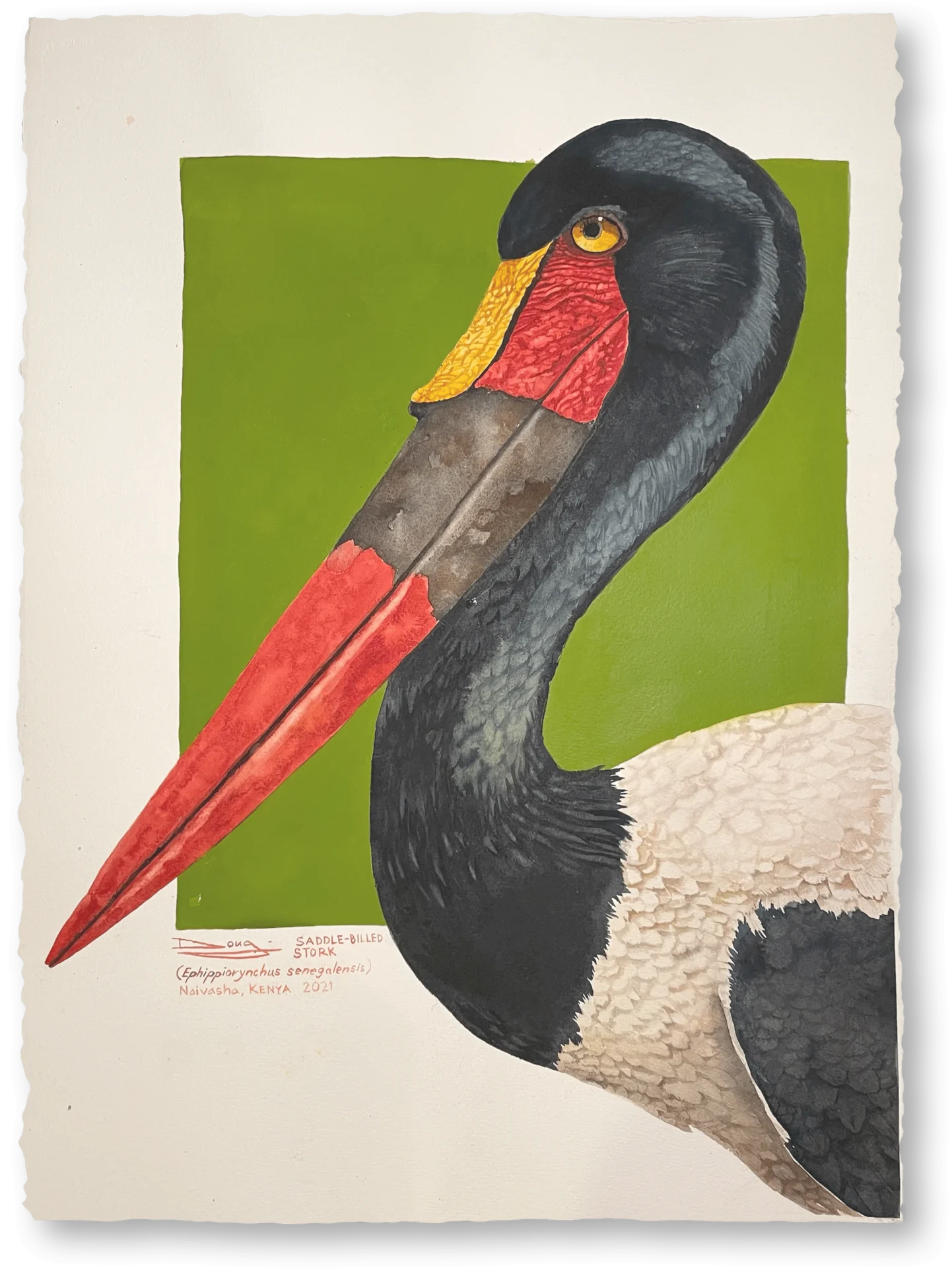
Watercolor, 31″ x 23″, on Arches coldpress rough 300lb (reverse side): $8,000
The Saddle-billed Stork (Ephippiorhynchus senegalensis)
About Saddle Bills
A tall, lanky, black-and-white stork with a unique red, yellow, and black bill. The male has dark-brown eyes and a yellow wattle under the bill, and the female has yellow eyes and no wattle.
The slightly upturned bill can grow to 13″. In flight, the bird’s massive size, and the dark bands in the center of the white wings are diagnostic. Scarce but conspicuous; mostly resident but can be partially nomadic in parts of the range.
Found singly or in pairs at rivers and large undisturbed wetlands, foraging for favorites like catfish, but it will also take frogs, small wading birds, and insects.
Range Map of the Saddle Billed Stork

About Saddle Bills around lake Naivasha
Lake Naivasha National Park is a haven for birders, that supports abundant birdlife. The park is dominated by papyrus swamps and acacia woodland and is home to grebes, cranes, herons, fish eagles, and storks of many species, including this resplendent saddle-billed female. located nearby the park which provides wonderful birding habitat. Lake Naivasha national park is located 13 kilometers away from Hell’s Gate National Park where birds like Bearded Vulture and Verreaux’s Eagle can be viewed around the towering cliffs.
About My commitment to saddle-billed stork conservation
25% of all proceeds from saddle-billed stork art and merchandise is donated to Kenya Bird of Prey Trust, to help with their ongoing community projects to clean up Lake Naivasha, which is the home of their raptor sanctuary and to monitor its incredibly rich and diverse bird life, including raptors, but also positively affecting populations of water fowl, such as great crested grebe, kingfishers, cormorants, several endangered heron species and of course, the occasional and ever characterful saddle-billed storks (the harlequins of storks).
About the painting:
I love the dramatic primary coloration of the bill and “saddle” and the piecing yellow eyes of the female.
Started with two photos from renowned wildlife photographers Manoj Shah and Debi Dalio, comped together to add the sheen of Debi’s captured neck plumage to the regal pose of Manoj’s primary photo. I stripped out the background and played with various palettes before settling on the deep fern green, which I ended up painting in Gouache to achieve a flat matt look. The black parts were applied using a very loose wet-on-wet wash, charging Payne’s grey with Burnt Umber and Prussian Blue. The sheen was then added using Payne’s Grey and glazed with Prussian Blue and Viridian Green, while the white feathers were toned using Yellow Ochre, Burnt Sienna, and a touch of Raw Umber. The Red of the bill was Deep Crimson with Alizarin Crimson shading, and the yellow was Chromium Yellow Bright, Hansa Yellow and a touch of Yellow Ochre, while the black of the bill was done using wet-on-wet and glazing, of a mix of Payne’s Grey, Prussian Blue and Burnt Umber for the base with some deliberate blooming, glazed over with Raw and Burnt Umber.
Key Conservation Focus Areas
Wetlands Protection & Restoration
Protecting wetlands, floodplains, and waterways from degradation (e.g., from dam construction, overfishing, Hyacinth infestation).
Research & Monitoring
Address the lack of data by conducting surveys to understand population trends and threats.
Captive Breeding Programs
Zoos in North America and Europe participate in studbooks (like the NA Regional Studbook) to maintain sustainable captive populations, although breeding success varies.
My saddle-billed stork Conservation Commitment
25% of all proceeds
from “saddle-billl” artwork and merchandise goes to Kenya Bird of Prey Trust for their lake Naivasha projects.
Buy the Original or Prints
Coming Soon: Custom Frames and Matt boards - Over 100 styles!!!