
"Gene" The Augur Buzzard, Kenya Bird of Prey Trust

Watercolor, 22″ x 30″, on Arches rough 300lb $5,000
(Giclée signed and numbered, limited edition prints and poster prints available)
To zoom in, click on the image, then click the magnifying glass in the upper right corner of the page.
The Augur Buzzard (Buteo augur)
About Augur buzzards
Gene is an Augur Buzzard, (Buteo augur).
The Augur is a “Chunky buzzard with a reddish tail. The color of the underparts varies: they are normally white, but can be completely black. Immature is brown on the back and pale below. Found in hilly and mountainous terrain, in a wide variety of habits including semi-desert, savanna, woodland, grassland, heath, and tree plantations. Call is a short, emphatic yelp. Distinctive across most of its range, but can be confused with Jackal Buzzard in the small area of overlap. Separated there by the pale underwing.”
–E bird
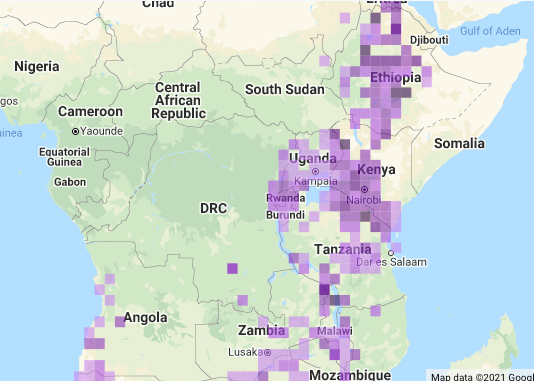
Range Map of the Augur Buzzard
About Gene
Gene was rescued a couple of years ago by Shiv Kapila from the Kenya Bird of Prey Trust, in Naivasha. While somewhat shy, he is less reclusive than his cousin and neighbor, the Black Goshawk. He poses with austere dignity on a branch in his spacious enclosure, calmly awaiting his impending release.
He is a bit of a poseur, and one gets the impression that he knows just how striking his charcoal, whit eand russet plumage is, as he struts back and forth, eyeballing his audience with his hallmark piercing, judgemental gaze.
Conservation Efforts:
- Raptor-safe Power line advocacy:
Efforts have been made over the last decade t o lobby government to insulate power lines, which are the number one killer of raptprs in Kenya. - Research and Monitoring:
Ongoing research is crucial to understand the augur’s diet, mating and nesting habits, their population dynamics, and the effectiveness of conservation interventions. to better deal with their decline in numbers. - Education:
Indigenous farmers have a fear/distrust of most raptors, and benefit from beak-to-nose exposure and education of the critical role raptors play in the ecosystem, as well as the opportunities in ecotourism from making rescue raptors accessible to the public.
About the painting:
I created this painting while vacationing at Diani Beach on the coast of Kenya (I traveled with my paints, paper and 3ft x 2ft lightbox!), using reference photos I took while visiting the Kenya Bird of Prey Trust in Naivasha, a few months earlier. I was captivated by Gene’s stoic poise and piercing gaze and loved his chic black and white ermine-style plumage. As usual I composited several photos to get the right pose and transferred outlines to paper, which I taped to my lightbox.
I was happy with the deliberate blooms and the rich ochre coloring of the background panel, which I think offsets his minimalist plumage colors and beautiful feather patterning quite well. The whole work was done with a combination of wet on wet, wet on dry and glazing, with detailed over-painting restricted to the eyes and beak.
The picture was painted using Daniel Smith Finest, Winsor & Newton Artists, and Van Gogh Artists watercolors on Arches 300 lb cold press roughg, 100% rag paper, which I had to fly in from the states as you can’t buy Arches paper in Kenya. No white or black pigments were was used.
My Augur Buzzard Conservation Commitment
25% of all proceeds
from “Gene” artwork and merchandise goes to Kenya Bird of Prey Trust for their Raptor Rescue programmes.
Buy the Original or Prints
Coming Soon: Custom Frames and Matt boards - Over 100 styles!!!