"Last Bastion Of Calm" Mountain Bongo
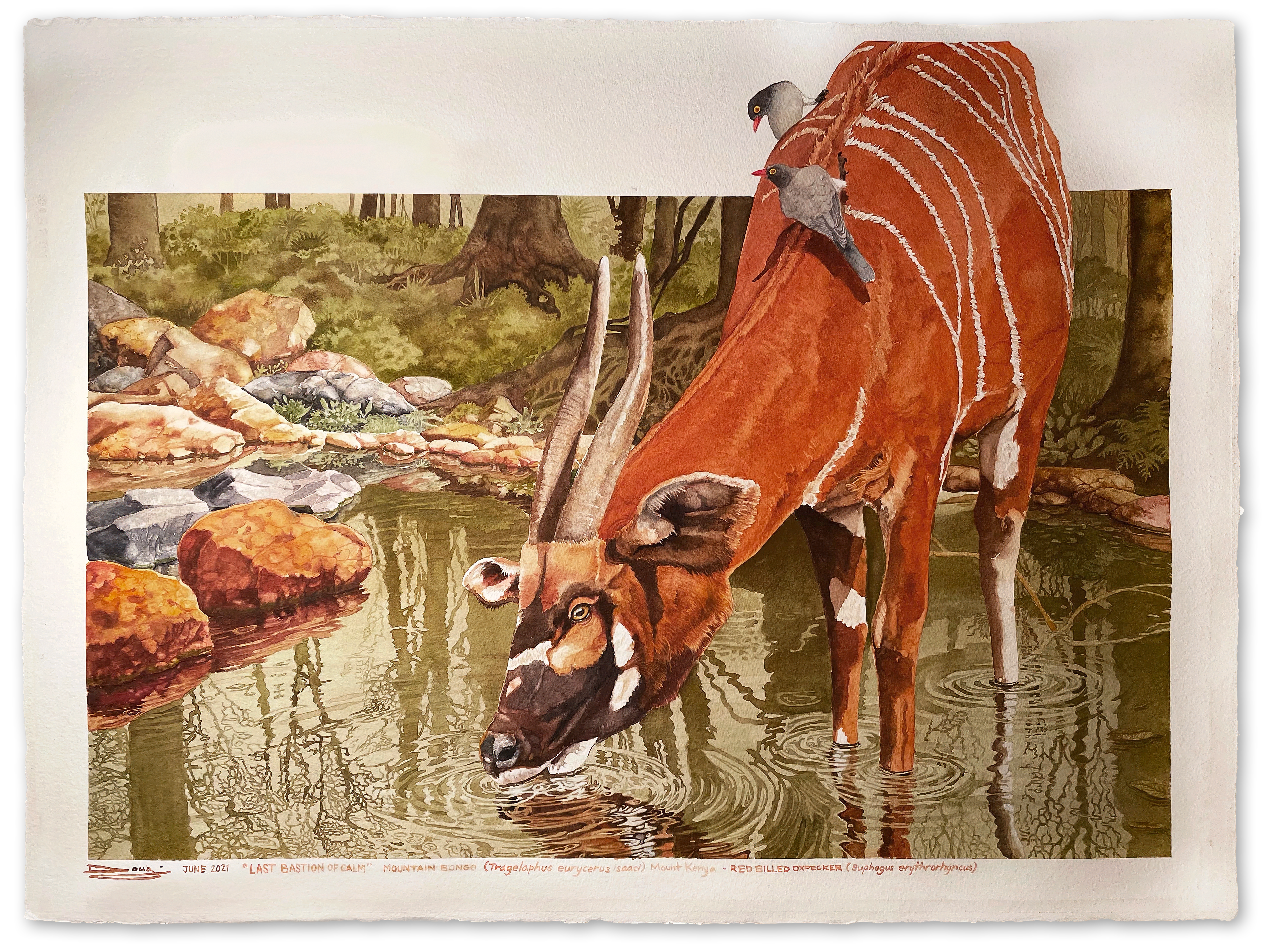
Watercolor, 30″ x 22″, on Lanaquarelle rough 300lb: $8,000.00 SOLD
(Giclée signed and numbered, limited edition prints and poster prints available)

To zoom in, click on the image, then click the magnifying glass in the upper right corner of the page.

The Mlountain Bongo (Tragelaphus eurycerus isaaci

About Mountain Bongos

From the Florida University Tropical Conservation website:

The Mountain Bongo (Tragelaphus eurycerus isaaci) is the largest and most endangered of the forest antelopes. With less than 100 left in the wild, they are listed as Critically Endangered on the IUCN Red List of Threatened Species. Bongos have undergone significant reduction in numbers and range due to habitat loss, poaching, human encroachment, and diseases. Through an international collaborative effort, our scientists are working to save the bongo and with it, the high-mountain ecosystem that supplies 80 percent of Kenya’s people with clean, fresh water.

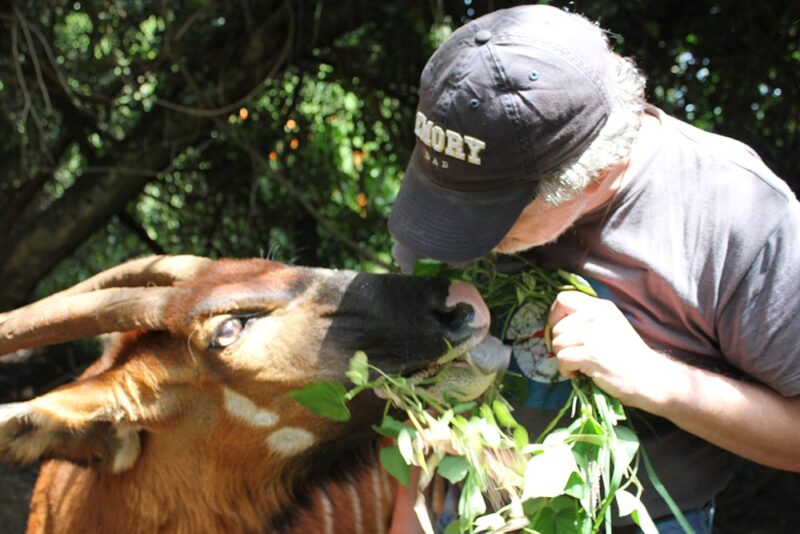
Me and one of the repatriateed Mountain Bongos at the Mount Kenya Rescue and Rehabilitation centre
About Bongos in Mount Kenya Rainforest

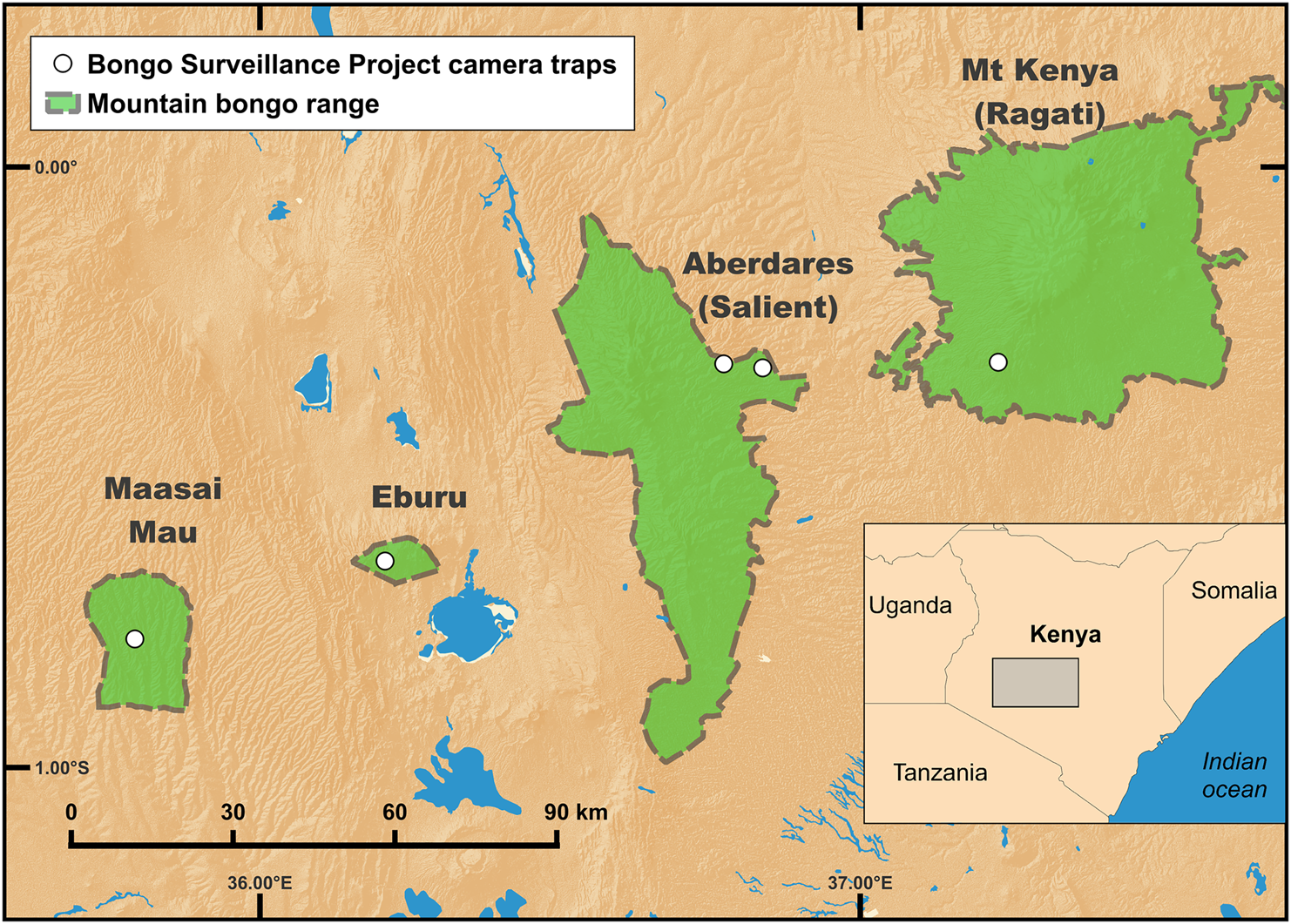
Bongos are rarely seen in large herds. Bulls are mostly solitary, while females with young form small herds of up to 10. They are mostly nocturnal. These small herds are scattered across the highlands of Mt. Kenya and the nearby Abadares.

The Mt. Kenya Trust works with the Kenya Wildlife Service (KWS), local communities and others to protect the forests of Mount Kenya. It operates patrol teams which remove traps and snares, arrest poachers and loggers, and fight forest fires. The Joint Wildlife Protection Team (JWPT) also consists of armed KWS rangers, while the Horse Patrol can reach inaccessible areas and is very effective at catching offenders. Habitat protection and monitoring of the small remaining populations is critical for their survival, while captive breeding and reintroduction to Mount Kenya could also play a role (there are more mountain bongo in captivity than in the wild). Tusk supports the Bongo Surveillance Programme, which studies and protects their largest population of about 50 in the Aberdares.

The Mawingu Mountain Bongo Sanctuary is a fundamental element of the National Recovery and Action Plan for the Mountain Bongo 2019 – 2023. The Sanctuary represents the next step in the re-wilding process for the Mountain Bongo as part of the MKWC breeding programme and will support the National Bongo Task Force in the reintroduction of the Mountain Bongo to indigenous habitats such as Ragati, Eburu, Mau and Aberdares forests.

Range Map of the Mountain Bongo
About the painting:

I had the privilege of not only seeing, but feeding and petting half a dozen mountain bongos, held as part of a breeding programme in the Sweetwaters Orphanage.  The orphanage was home at the time (2017) to not only bongos, but colobus, sykes and vervet monkeys, a buffalo calf, hyrax, and incongruously, several llamas.

I took many photos, and used several as reference as well as finding a Mt Kenya rainforest pool image and some stock images of bongos. In the end I composited my head photo onto a stock body and added some red-billed oxpeckers. There was no reference for the ripples so I used images of grebes on lakes as the basis and just sort of worked the rest out in my head.


I planned the ripples out by drawing concentric ellipse paths in perspective, then applying a stroke to the paths. I used this as a guide when creating the highly detailed outlines in pencil.

For this painting, I wanted to attempt another pure watercolor – but had to resort to the tiniest overlays of gouache for the white parts of the ripple reflections.

I mixed the base green for the background and reflections using Daniel Smith’s Green Apatite Genuine, Burnt Sienna Light, and Yellow Ochre, with touches of Burnt Umber. The bongo’s unique, rich chestnut coat was made with Roasted French Ochre, Burnt Sienna Light, Yellow Ochre, Permanent Orange, and Mayan Orange.

awf logo 005 over

My Bongo Conservation Commitment

25% of all proceeds 

from Bongo artwork and merchandise goes to the African Wildlife Foundation, in Kenya, for their Mount Kenya Biongo programme.

Buy the Original or Prints

Coming Soon: Custom Frames and Matt boards - Over 100 styles!!!

African Wildlife Foundation

For 60 years, African Wildlife Foundation has been ahead of the curve in developing innovative conservation strategies so wildlife, wild lands, and people can thrive. Our approach is uniquely comprehensive, addressing not only direct threats to wildlife like poaching and habitat loss, but also working with communities and governments to ensure that African conservation is truly African owned and led.

Bongos are only found in rainforests with dense undergrowth across tropical Africa. Specifically, they are found in the lowland rainforests of West Africa and the Congo Basin to the Central African Republic and southern Sudan. They thrive at the forest edge and in new growth areas that occur after disturbances.

The African Wildlife Foundation’s mountain bongo project co-ordinates with Mt. Kenya Trust, the Kenya Wildlife Service (KWS), local communities and others to protect the forest habitats of mountain bongo at Mount Kenya. Together, they operate patrol teams which remove traps and snares, arrest poachers and loggers, and fight forest fires.

The Joint Wildlife Protection Team (JWPT) also consists of armed KWS rangers, while the Horse Patrol can reach inaccessible areas and is very effective at catching offenders. Habitat protection and monitoring of the small remaining populations is critical for their survival, while captive breeding and reintroduction to Mount Kenya could also play a role (there are more mountain bongo in captivity than in the wild).

Our approach to saving the Mountain Bongo

Securing Habitat and Corridoors

Agricultural Training to Limit Deforerstation

Collaboration with Agencies and Communities

Monitoring Populations

Help Fund poaching Patrols

African Wildlife Foundation works with governments and villages to designate wildlife corridors — large swaths of land that bongos can use to roam freely and safely from one park, or country, to another. Corridors link protected areas and allow wildlife to follow rains or travel to their calving grounds without disturbing human settlements.

Challenges

Natural predators take their toll on bongo populations.

Young bongos are vulnerable to pythons, leopards, and hyenas. Lions have also been reported to kill bongos.

Today, the bongo’s biggest threat is humans.

Bongos are the primary target of tourist safari hunting in central Africa, and the demand has been increasing during the past decade. Large-scale and continuous hunting has completely eliminated this species in some areas.

African Wildlife Foundation

For 60 years, African Wildlife Foundation has been ahead of the curve in developing innovative conservation strategies so wildlife, wild lands, and people can thrive. Our approach is uniquely comprehensive, addressing not only direct threats to wildlife like poaching and habitat loss, but also working with communities and governments to ensure that African conservation is truly African owned and led.

Bongos are only found in rainforests with dense undergrowth across tropical Africa. Specifically, they are found in the lowland rainforests of West Africa and the Congo Basin to the Central African Republic and southern Sudan. They thrive at the forest edge and in new growth areas that occur after disturbances.

The African Wildlife Foundation’s mountain bongo project co-ordinates with Mt. Kenya Trust, the Kenya Wildlife Service (KWS), local communities and others to protect the forest habitats of mountain bongo at Mount Kenya. Together, they operate patrol teams which remove traps and snares, arrest poachers and loggers, and fight forest fires.

The Joint Wildlife Protection Team (JWPT) also consists of armed KWS rangers, while the Horse Patrol can reach inaccessible areas and is very effective at catching offenders. Habitat protection and monitoring of the small remaining populations is critical for their survival, while captive breeding and reintroduction to Mount Kenya could also play a role (there are more mountain bongo in captivity than in the wild).

Our approach to saving the Mountain Bongo

Securing Habitat and Corridoors

Agricultural Training to Limit Deforerstation

Collaboration with Agencies and Communities

Monitoring Populations

Help Fund poaching Patrols

African Wildlife Foundation works with governments and villages to designate wildlife corridors — large swaths of land that bongos can use to roam freely and safely from one park, or country, to another. Corridors link protected areas and allow wildlife to follow rains or travel to their calving grounds without disturbing human settlements.

Challenges

Natural predators take their toll on bongo populations.

Young bongos are vulnerable to pythons, leopards, and hyenas. Lions have also been reported to kill bongos.

Today, the bongo’s biggest threat is humans.

Bongos are the primary target of tourist safari hunting in central Africa, and the demand has been increasing during the past decade. Large-scale and continuous hunting has completely eliminated this species in some areas.